Counter Surveillance Services for Executives
An executive notices the same vehicle near the office, at a child’s school event, and again outside a hotel during a business trip. That pattern may have an innocent explanation. It may also require a careful, evidence-focused response. Counter surveillance services for executives are designed to assess such concerns methodically, without assumptions, unnecessary escalation, or conduct that creates legal or reputational risk.
For corporate leaders, public-facing professionals, and executives involved in sensitive transactions, litigation, labor matters, or high-profile decisions, the question is rarely whether a situation feels concerning. The question is what can be verified, what information should be preserved, and what response is appropriate under the circumstances.
What Counter Surveillance Services for Executives Address
Counter-surveillance is the professional assessment of whether a person, location, route, or activity is being monitored or followed. The objective is not to create a dramatic confrontation or to confirm a suspicion at all costs. It is to identify observable facts, evaluate patterns, distinguish legitimate activity from potential surveillance, and provide reliable information for informed security, legal, or operational decisions.
This work may be appropriate when an executive reports repeated unfamiliar vehicles, recurring individuals at multiple locations, unusual attention around a residence or office, suspicious activity during travel, or concerns arising from a dispute, termination, investigation, or public controversy. It may also be appropriate when a company needs to evaluate risks associated with a sensitive meeting, leadership transition, merger, internal investigation, or confidential project.
Counter-surveillance differs from routine executive protection. Executive protection focuses on immediate safety and movement planning. Counter-surveillance focuses on detecting, documenting, and assessing potential monitoring activity. The two disciplines can support one another, but they are not interchangeable. The right approach depends on the available facts, the level of concern, the executive’s daily routines, and applicable law.
Begin With a Measured Threat Assessment
A professional response begins with a confidential consultation and a disciplined review of the known facts. The investigator should seek specific details: dates, times, locations, descriptions, photographs or video already obtained, vehicle information, witness observations, prior incidents, and any underlying business, legal, or personal circumstances that could bear on the concern.
Context matters. A vehicle observed several times may belong to a neighbor, delivery provider, contractor, journalist, process server, or another person with a legitimate reason to be nearby. Conversely, a collection of seemingly minor incidents may take on greater significance when viewed alongside threats, litigation, employment actions, online harassment, or efforts to obtain confidential business information.
The assessment should also identify practical objectives. Some clients need a discreet determination of whether a pattern exists. Others need documentation that can be evaluated by legal counsel, corporate security, law enforcement, or an insurer. In matters involving active threats or immediate danger, the appropriate first step may be contacting law enforcement or emergency services rather than initiating a private investigation.
A sound plan considers the possibility that no actionable surveillance will be found. That is still a useful result when it is based on careful observation and documented analysis rather than speculation. It can prevent an organization from committing resources to an unsupported concern while helping the executive regain a clearer understanding of the situation.
How a Counter-Surveillance Inquiry May Proceed
The methodology should be tailored to the case rather than applied as a standard package. Depending on the facts and lawful authority, an investigation may involve discreet observation, route and location assessment, pattern analysis, review of available imagery, open-source intelligence research, background research on identified persons or vehicles, and coordination with counsel or security personnel.
Surveillance detection routes may be considered in limited, appropriate circumstances. These are planned movements intended to reveal whether the same person or vehicle appears repeatedly through lawful observation. They are not reckless driving exercises, confrontations, or attempts to force another party into revealing themselves. A poorly planned route can increase safety risks, alert a subject, or generate misleading observations. It should be used only when the facts, environment, and client objectives justify it.
Investigators may also evaluate vulnerabilities in an executive’s predictable routines. Regular departure times, frequently used entrances, publicly shared travel details, and unprotected residential or office access points can provide opportunities for unwanted observation. The purpose of this review is not to impose a burdensome lifestyle change. It is to identify reasonable adjustments that may reduce exposure while preserving the executive’s ability to work and travel effectively.
When activity is observed, documentation is essential. Contemporaneous notes, time-stamped imagery, location details, descriptions, and a clear explanation of how the information was obtained help preserve the integrity of findings. Professional reporting should separate verified observations from analytical assessments and avoid overstating what the evidence proves.
Digital Concerns Require a Separate Analysis
Executives often associate surveillance with vehicles, cameras, or physical following. Yet concerning activity may also involve digital exposure. Public social media posts, data-broker information, compromised accounts, unauthorized access to devices, or the disclosure of travel plans can reveal more than an executive realizes.
Digital concerns should not be treated as proof that a device has been compromised. A mobile device behaving unusually may have a technical explanation unrelated to monitoring. A qualified assessment can help determine whether digital forensic examination, account-security review, evidence preservation, or other specialized services are warranted.
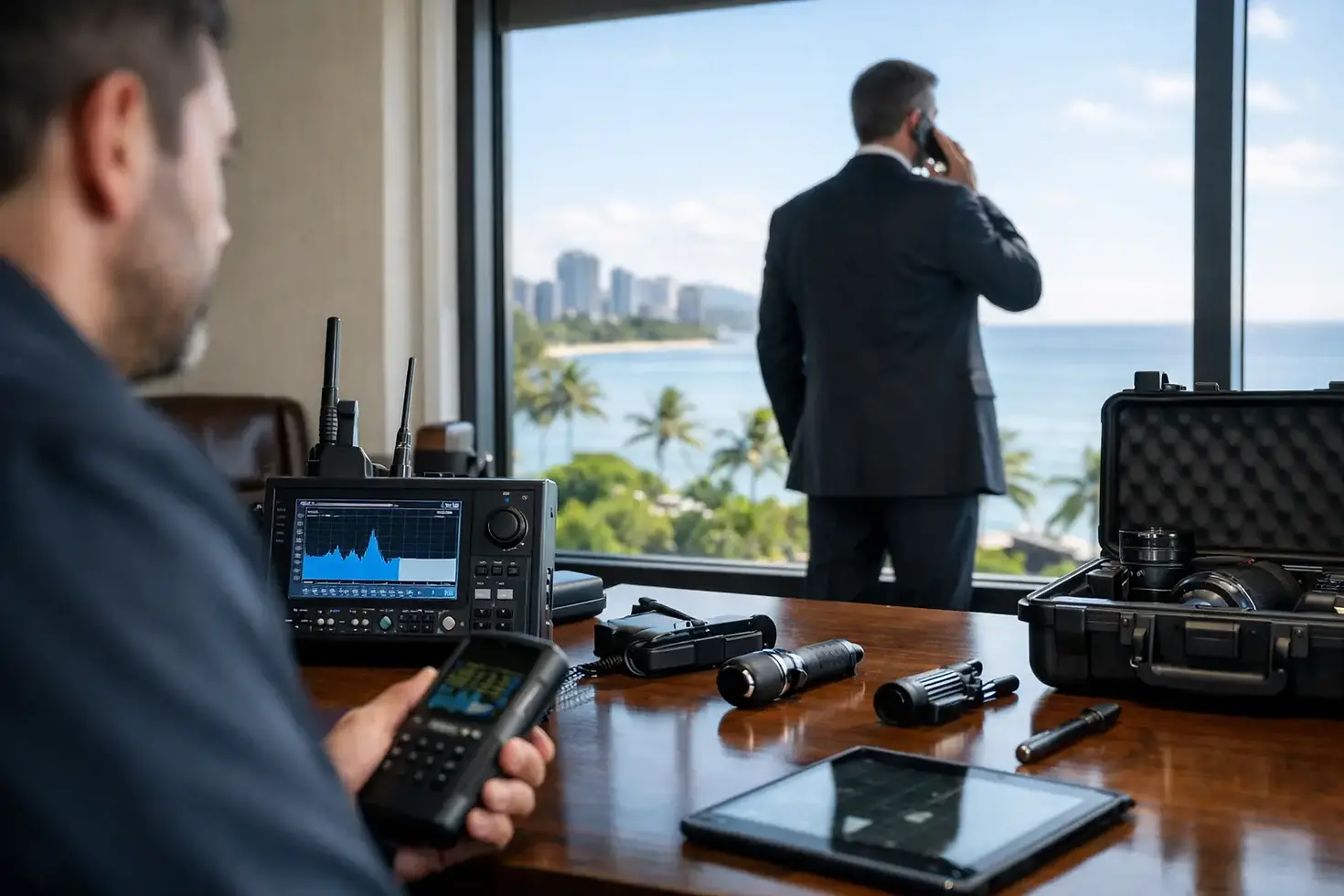
Technical Surveillance Countermeasures, commonly called TSCM, are another distinct service area. TSCM concerns the detection and assessment of unauthorized electronic surveillance devices in offices, residences, vehicles, or meeting spaces. It may be appropriate where there is a credible concern about covert recording or electronic monitoring. Counter-surveillance and TSCM can be coordinated when facts support both physical and technical risk, but one should not be used as a substitute for the other.
Legal Boundaries Protect the Client and the Findings
Counter-surveillance must be conducted within applicable laws, licensing requirements, property rights, privacy expectations, and jurisdictional limitations. Investigators do not gain special authority to trespass, access protected accounts, intercept private communications, track a person unlawfully, or obtain restricted information through deception.
These boundaries are not administrative details. Improperly obtained information can undermine a security response, create civil or criminal exposure, and limit the usefulness of evidence in a legal matter. For attorneys and corporate legal departments, lawful collection methods and clear documentation are especially important when findings may inform litigation strategy, internal action, regulatory decisions, or referral to law enforcement.
In Hawaii and other jurisdictions, the legal and practical conditions of an investigation can vary significantly. Dense urban environments, resort locations, private residential communities, interisland travel, and remote areas each present different visibility, access, and logistical considerations. A licensed investigative firm should evaluate those realities before recommending an approach.
Selecting an Appropriate Investigative Response
Executives and organizations should look for a provider that begins with questions rather than promises. The investigator should be able to explain the proposed scope, likely limitations, legal considerations, reporting process, and circumstances that would require a change in strategy.
Relevant experience includes lawful field surveillance, intelligence analysis, evidence preservation, digital forensic awareness, and the ability to communicate findings clearly to counsel, security leadership, or decision-makers. Confidentiality protocols also matter. Sensitive information should be handled on a need-to-know basis, with a clear understanding of who will receive updates and final reporting.
Kiamalu Consulting & Investigations, LLC evaluates counter-surveillance concerns based on the client’s specific facts, objectives, available evidence, and jurisdictional requirements. The goal is not to validate fear. It is to develop a practical investigative strategy capable of producing defensible findings.
A concern about surveillance deserves neither dismissal nor dramatization. Preserve what has been observed, avoid direct confrontation, and seek professional guidance when the pattern is credible or the stakes are high. A measured inquiry can turn uncertainty into usable information and help leadership make the next decision with greater confidence.


Comments